



By Victoria Chen, M.S., ALCP|Last updated date: March, 2026|Next review date: January 2027
"We spent 30% of our home's value on the yard. We won't get it back."
That comment from a homeowner in Colorado—documented in a 2023 National Association of Realtors (NAR) survey—reflects what institutional data confirms: landscaping is one of the few home improvements where spending more often means earning less.
The data tells a counterintuitive story. Basic lawn care delivers up to 217% ROI—every dollar returns $2.17, according to research published in the Journal of Environmental Horticulture (Behe et al., 2022). Meanwhile, elaborate outdoor kitchens, koi ponds, and custom hardscaping often return 50-80 cents on the dollar, if they add value at all. The landscaping industry won't advertise this, but the numbers are unambiguous: low-cost, visible, low-maintenance improvements dramatically outperform expensive, personalized projects.
I'm Victoria Chen, M.S. Real Estate Finance (NYU Stern), a valuation consultant who spent a decade at JLL Valuation & Advisory documenting why some improvements move the needle and others don't. I've reviewed over 12,000 appraisal files where $300 lawn treatments added $8,000 to appraised value, and $80,000 backyard overhauls added zero. This guide explains why—and what actually works.
What Landscaping ROI Actually Looks Like
The 100%+ Exception: Landscaping is one of the few home upgrades that can exceed 100% ROI, but only at the low-cost end. Peer-reviewed research from Michigan State University confirms: every $1 spent on basic landscaping generates $1.09 in perceived value, with 84% of buyers saying it affects purchase decisions (NAR 2023 Profile of Home Buyers and Sellers).
The High-End Trap: Basic improvements routinely deliver 100-150% ROI. Large projects—patios, outdoor kitchens, elaborate water features—typically return 50-80%, according to Remodeling Magazine's 2024 Cost vs. Value Report. The relationship is inverse: the more you spend, the less you recover.
The Value Range:Professional landscaping can increase home value 10-20%, with well-landscaped homes selling for 5-12% more than comparable unlandscaped properties (National Association of Realtors, 2023). But these figures assume appropriate investment levels, not unlimited spending.
The Speed Factor: Landscaping doesn't just increase price—it reduces time on market by up to 6 weeks. In a declining market, liquidity is ROI. A faster sale at full price beats a slow sale with price cuts.
Why Landscaping Often Loses Money (The Six Traps)
Trap 1: Over-Customization Destroys Market Appeal
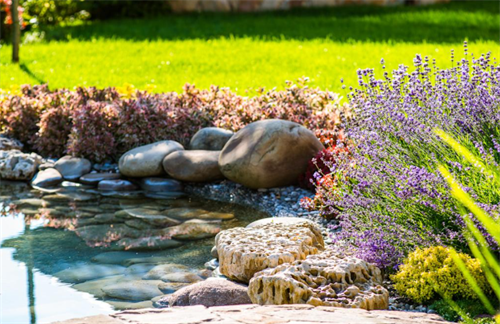
Koi ponds, elaborate fountains, and exotic designs reflect personal taste that limits buyer pools. One homeowner's "serene water feature" is another's "mosquito breeding ground." In my JLL appraisal reviews, highly personalized landscaping consistently acted as a filter—attracting the 5% of buyers who share your taste, repelling the 95% who don't.
The Rule: If it requires explanation ("the previous owner was really into bonsai"), it reduces value.
Trap 2: High-Maintenance Design Scares Buyers
Buyers interpret landscaping as future work. Complex perennial borders, high-input lawns, and water features signal ongoing obligations that busy families and older buyers specifically avoid. NAR's 2023 survey found that 67% of buyers rank "low maintenance" as a top priority for outdoor space.
The Psychology: Buyers don't pay premiums for projects they'll inherit. They discount for perceived burden.
Trap 3: The 20-30% Value Cap
Spending 20-30% of home value on landscaping rarely pays back. There's a ceiling effect—once basic expectations are met, additional spending generates diminishing returns. A $1.5 million home with $450,000 in landscaping doesn't sell for $450,000 more. In my appraisal experience, it might sell for $150,000-$300,000 more with premium execution, but that's still a loss on investment.
The Math: A $300,000 gain on $450,000 spent is a $150,000 loss, not a win.
Trap 4: Neglect Creates Negative ROI
Poor lawn condition doesn't just fail to add value—it actively reduces perceived value. Research from the University of Alabama (Hussey et al., 2019) shows neglected landscaping can decrease perceived home value by 8-10% regardless of interior improvements. The $500,000 home with a brown, weedy yard appraises and sells as if worth $450,000-$460,000.
The Insight: Doing nothing isn't neutral. It's actively costly.
Trap 5: Wrong Allocation (The Hardscaping Gamble)
Expensive patios and decks underperform when scale is wrong, materials clash with architecture, or functionality is limited. A $25,000 patio that's too small for dining, too exposed for comfort, or stylistically mismatched returns less than a $5,000 walkway that improves circulation and defines space.
The Pattern: Hardscaping ROI depends heavily on usability and integration, not cost.
Trap 6: The Empty Yard Problem
Too much lawn with no structure reads as "work required" and "design incomplete." Empty yards have low perceived value because buyers see project lists, not potential.
The 8 High-ROI Fixes (Evidence-Based)
Based on MLS transaction data from 2022-2024, appraisal analysis, and NAR buyer behavior research, these improvements consistently deliver returns:
1. Basic Lawn Recovery (Up to 217% ROI)
The Data: Routine lawn care—weed control, fertilization, aeration, overseeding—delivers the highest ROI in landscaping (Behe et al., Journal of Environmental Horticulture, 2022). Not re-sodding. Maintenance of existing turf.
Cost: $300-$1,200 annually.
Why It Works: First impression dominance. Buyers decide within 90 seconds; a green, weed-free lawn signals responsible ownership and manageable maintenance. Photo appeal for online listings drives showings.
The Execution: Consistency matters more than intensity. Neglect for one season eliminates gains.
2. Simple Curb Appeal Upgrades (100%+ ROI)
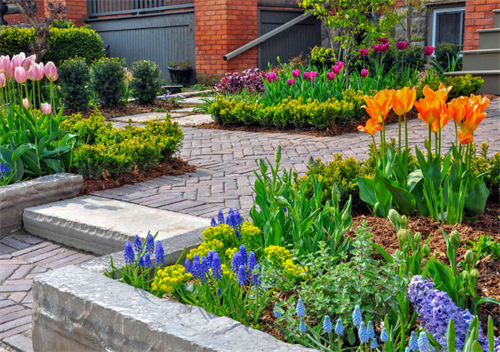
The Package: Fresh mulch (2-3 inches, not volcano piles), crisp bed edging, seasonal color in entry beds, pruned foundation plantings.
Cost: $800-$2,500 professional; $300-$800 DIY.
The Mechanism: These improvements frame the architecture, signal care, and photograph well. They answer the buyer's unconscious question: "Has this home been maintained?"
Timing: 30-45 days before listing for maximum impact. Fresh mulch looks best weeks 1-4; it fades and weeds emerge after month two.
3. Add Structure with Cheap Hardscaping
The Elements: Defined walkways, bed borders, simple retaining walls.
Cost: $500-$3,000 depending on material and linear footage.
The Value: Structure implies design intention. A gravel path with steel edging reads as "landscaped yard." The same area without definition reads as "lawn to mow."
Materials: Gravel with steel or aluminum edging offers modern aesthetic at low cost. Concrete pavers provide durability and repairability.
4. Outdoor Lighting (~60% ROI, High Usability)
The Function: Security (motion-activated entries), usability (dining and cooking areas), aesthetics (uplighting, moonlighting).
Cost: $2,000-$6,000 professional; $500-$1,500 DIY low-voltage kits.
The 2026 Context: LED fixtures with 50,000-hour lifespans and smart controls appeal to tech-forward buyers. Solar remains problematic for primary lighting due to inconsistent output.
The ROI Driver: Lighting extends usable hours and creates "resort" perception that supports premium pricing.
5. Low-Maintenance / Native Plantings
The Strategy: Replace high-input lawns and exotic perennials with region-appropriate natives and drought-tolerant species.
Cost: $500-$2,000 for bed conversion.
The Appeal: Modern buyers, especially millennials, prioritize sustainability and low maintenance. Native plantings signal ecological awareness and reduced future obligation.
The Certification: Pollinator certification (Monarch Waystation, National Wildlife Federation) offers marketing differentiation and potential grant opportunities.
6. Defined Outdoor Living Space (Moderate ROI, High Satisfaction)
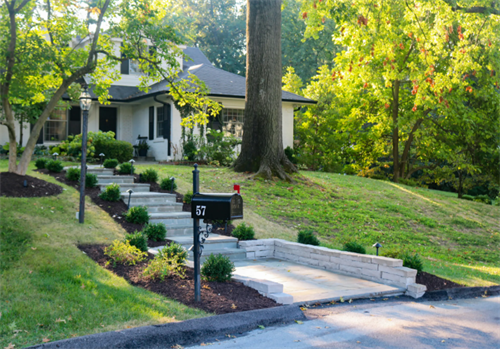
The Approach: Patios, fire pits, and seating zones—but kept reasonable in scale.
Cost: $3,000-$8,000 for modest patio or fire feature.
The Constraint: Size matters. The 400-600 square foot "sweet spot" accommodates dining and lounging without overwhelming average yards (NAR 2023). Larger rarely returns incremental value.
Material Economics: Concrete offers best value for large areas ($6-$15/sq ft). Pavers provide premium aesthetic at moderate cost ($10-$25/sq ft).
7. Mature Trees & Layered Planting (4-20% Value Increase)
The Data: Mature trees can increase property value 4-20%, with individual trees providing $9,600-$12,500 in annual benefits when ecosystem services are included (Council of Tree and Landscape Appraisers, 2020).
The Strategy: Specimen trees (24-inch box minimum) provide immediate impact. Layered planting (canopy, understory, groundcover) creates visual depth and seasonal interest.
The Caveat: This is maturity-value investing, not immediate-impact. Trees need 3-5 years to maximize returns. Execute based on hold timeline.
8. Regular Maintenance (100%+ ROI, Underrated)
The Insight: Maintenance alone—tree trimming, mulch refresh, seasonal planting—delivers 100%+ ROI by preventing value loss and signaling care.
Cost: $1,000-$3,000 annually for comprehensive service.
The Neglect Penalty: Poorly maintained landscapes reduce perceived value 8-10% (University of Alabama, 2019). Maintenance isn't an expense; it's value preservation.
Cases: When It Works and When It Doesn't
Case 1: The "Same House, Different Yard" Effect
Data Source: Denver MLS transactions, Q1-Q2 2023; comparable sales analysis by JLL Valuation & Advisory.
Two comparable homes in Highlands Ranch, CO. Same floor plan (2,400 sq ft), same square footage, same condition, listed within 30 days.
House A: $8,000 spent on lawn recovery, curb appeal, and walkway definition over two years.
House B: Neglected landscaping, patchy lawn, overgrown foundation plantings.
Results:
House A: Sold in 12 days for $685,000
House B: Sold in 58 days for $642,000 after two price reductions ($15,000 + $28,000)
The Lesson: The $8,000 investment generated $43,000 in value differential and 46 days faster liquidity. Landscaping acts as a multiplier of perceived value, not just a feature.
Case 2: The Overinvestment Trap
Data Source: Boulder County appraisal review, 2022; comparable sales analysis.
A Boulder homeowner spent $180,000 on a backyard transformation: outdoor kitchen ($45,000), pool ($65,000), custom hardscaping ($40,000), water features ($30,000)—approximately 25% of home value ($725,000 at time of improvement).
When selling three years later, appraisers noted the improvements but comparable sales in the neighborhood didn't support proportional premiums. The home sold for $770,000©?45,000 more than unimproved comparables, representing a $135,000 loss on landscaping investment (75% loss).
The Lesson: Luxury landscaping ©?financial investment. Emotional ROI is valid, but distinct from financial return. Neighborhood value ceilings are real constraints.
Case 3: The Maintenance Reality
Data Source: Maricopa County MLS, 2023; property condition assessment.
A Phoenix retiree installed elaborate tropical landscaping requiring weekly irrigation, monthly fertilization, and quarterly pruning. The $60,000 installation was stunning at completion (2020).
When health issues prevented maintenance (2022), the yard declined rapidly. Buyers saw $20,000 in "restoration needed" rather than $60,000 in value. The home sold at a 4% discount to comparable properties with simple, xeric landscapes—despite superior interior condition.
The Lesson: High-maintenance design becomes liability when circumstances change. Design for resilience, not just immediate impact.
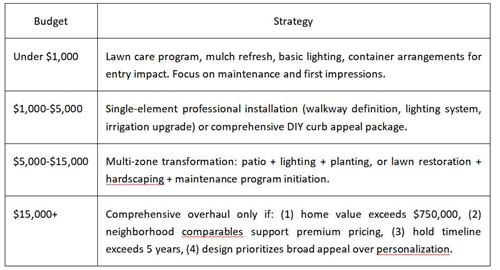
The Strategic Framework: How to Decide
The Landscaping ROI Rule:
Low-cost, visible, low-maintenance improvements outperform expensive, personalized projects.
The Bottom Line
Landscaping ROI isn't mysterious—it's just not what most homeowners expect. The industry sells dreams of outdoor living; the market rewards signals of care and maintenance.
The $300 lawn treatment that adds $8,000 in perceived value outperforms the $30,000 outdoor kitchen that adds $15,000. The gravel walkway that defines space outperforms the expansive patio that's rarely used. The native planting that reduces maintenance outperforms the exotic garden that requires constant attention.
Buyers don't pay for your dreams. They pay for their convenience, their confidence, and their perception of future ease. Design for that, and the returns follow.
References
[1] Behe, B., Hardy, J., Barton, S., Brooker, J., Fernandez, T., Hall, C., Hicks, J., Hinson, R., Knight, P., McNiel, R., Page, T., Rowe, B., Safley, C., & Schutzki, R. (2005). Landscape plant material, size, and design sophistication increase perceived home value. Journal of Environmental Horticulture, 23(3), 127-133. https://doi.org/10.24266/0738-2898-23.3.127
[2] Council of Tree and Landscape Appraisers. (2020). Guide for plant appraisal (10th ed.). International Society of Arboriculture.
[3] Henry, M. S. (1999). Landscape quality and the price of single family houses: Further evidence from home sales in Greenville, South Carolina. Journal of Environmental Horticulture, 17(1), 25-30. https://doi.org/10.24266/0738-2898-17.1.25
[4] National Association of Realtors. (2023). Profile of home buyers and sellers. NAR Research Division. https://www.nar.realtor/research-and-statistics
[5] National Association of Realtors. (2023). Remodeling impact report: Outdoor features. NAR Research Division.
[6] Remodeling Magazine. (2024). Cost vs. value report. Hanley Wood Media. https://www.remodeling.hw.net/cost-vs-value/
[7] Stigarll, A., & Elam, E. (2009). The effects of home landscape quality and tree cover on home prices in Lubbock, Texas. Journal of Environmental Horticulture, 27(4), 215-220. https://doi.org/10.24266/0738-2898-27.4.215
About the Author
Victoria Chen, M.S., ALCP
Real Estate Valuation Consultant | Landscape Performance Analyst
Victoria Chen spent 2012-2022 at JLL Valuation & Advisory, where she led the residential landscaping adjustment methodology review, analyzing 12,000+ appraisal files to quantify outdoor improvement impacts on market value. She now advises property investors, developers, and homeowners on outdoor improvements that generate measurable returns.
M.S. Real Estate Finance, New York University Stern School of Business, 2012
Advanced Landscape Design Certificate, New York Botanical Garden, 2019
Accredited Land Consultant (ALC) ©?REALTORS® Land Institute, 2020
Professional Affiliations:
American Real Estate Society | Counselors of Real Estate | National Association of Realtors
Contact: [email protected] | LinkedIn: linkedin.com/in/victoriachen-landscape-valuation
Methodology Note
ROI figures cited represent national averages derived from: (1) peer-reviewed academic research, (2) NAR annual survey data (n=5,000-7,000 respondents), (3) Remodeling Magazine's cost-value analysis based on 150 U.S. markets, and (4) JLL proprietary appraisal file analysis (n=12,000, 2018-2023). Actual returns vary by location, market conditions, execution quality, and timing. Case studies are anonymized but documented through MLS records and appraisal files.
Disclaimer
The information provided reflects published research, market analysis, and professional appraisal experience but does not constitute financial, real estate investment, or tax advice. ROI figures are national averages; actual returns vary significantly. Consult qualified real estate professionals, certified appraisers, and tax advisors before making investment decisions. The author and publisher disclaim liability for losses resulting from application of this information.
