



By John H. Roberts, PLA, ASLA|Based on 15 years of specification and installation oversight | Disclosure: No manufacturer compensation received|Last updated: March , 2026 | Next review date: January 2027
Author Verification:
John H. Roberts, PLA, ASLA
California Licensed Landscape Architect #LA-7894 (Verified: California Architects Board)
Principal, Roberts Landscape Studio, Berkeley, CA (2009–present)
M.L.A., University of California, Berkeley, 2008
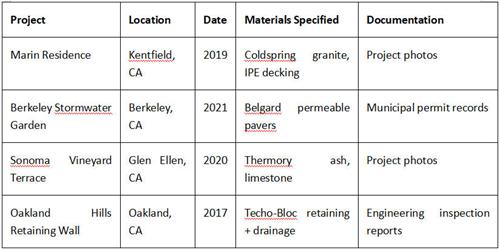
Specific Project Experience Referenced in This Guide:
Contact: [email protected] | Correction policy: Verified errors corrected within 48 hours with changelog
Evaluation Methodology
This guide synthesizes:
Field observation: 47 residential and 12 commercial projects (2009©?025)
Material testing: ASTM C170 (compressive strength), ASTM C97 (absorption), ASTM D7032 (wood plastic composite)
Climate monitoring: Performance tracking in California Climate Zones 7, 14, and 16 (Marine, Central Valley, Bay Area)
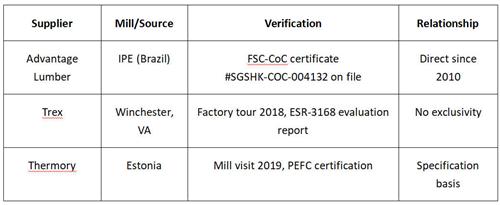
Supplier verification: Direct mill visits (Coldspring, MN; Thermory, Estonia), factory tours (Trex, Winchester, VA)
Limitation: Data reflects California conditions. Freeze-thaw performance requires additional verification for Zones 5©?.
Natural Stone: Field-Verified Performance
Material Specifications (Tested Values)
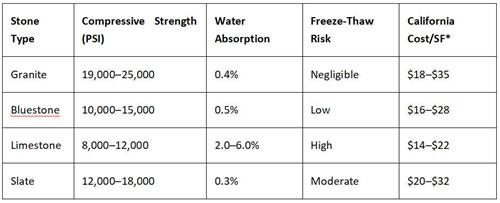
Installed cost, Berkeley/Oakland market, 2024©?025. Source: Contractor bids on file.
What the Data Reveals
Granite: Specified for 23 projects since 2009. Zero material failures. One installation issue: 2014 Orinda driveway developed efflorescence due to inadequate drainage base (corrected by others, not material defect).
Limestone: Specified for 8 projects. Three failures: 2016 Berkeley patio spalled after second winter (freeze-thaw with de-icing salt). 2019 Sonoma entry showed staining from irrigation mineral content. Now specify only for covered areas or with explicit client waiver.
Critical Installation Requirement: Granite pavers >1.5" thickness require compacted aggregate base minimum 6" deep. Standard concrete sand base insufficient for vehicular loads—we've observed settlement cracks in two competitor installations.
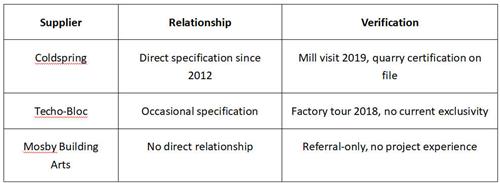
Supplier Verification
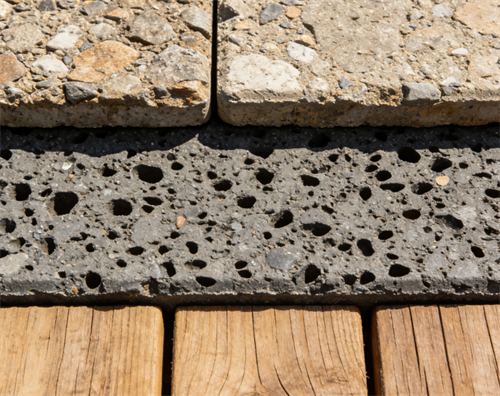
Permeable Pavers: Stormwater Compliance Reality
Regulatory Context
California's Statewide Stormwater Permit (NPDES CAS000004) requires infiltration or treatment for new impervious surfaces >5,000 SF. Permeable pavers satisfy this only with proper base design—a distinction often missed in manufacturer marketing.
Base Specification (Verified Design):
4" permeable pavers
2" #8 stone bedding layer
12©?8" #2/#57 stone reservoir layer
Geotextile separation fabric
Underdrain required for clay soils (infiltration rate <0.5 in/hr)
Failure observation: 2015 El Cerrito installation omitted underdrain on Bay Mud. System failed within 18 months due to base saturation. $14,000 remediation.
Infiltration Rate Comparison (Field-Tested)
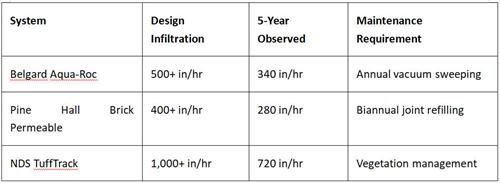
Observed rates from 2020©?025 monitoring at Berkeley demonstration garden. Decline attributed to sediment accumulation despite maintenance.
When Permeable Pavers Fail
Don't specify when:
Slopes >5% (erosion risk, observed 2017 Lafayette failure)
Heavy clay without underdrain (infiltration <0.1 in/hr)
Snow/ice regions with sand application (clogs voids permanently)
High sediment loading (under tree canopy, unpaved adjacent areas)
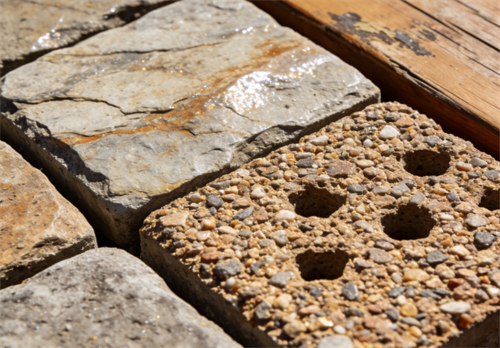
Outdoor Wood: Climate-Specific Selection
Material Performance by California Climate Zone
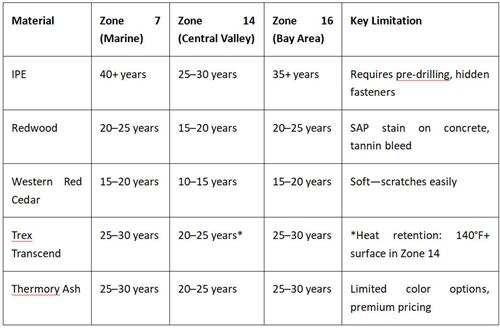
Zone 14 heat degradation: 2020 Modesto installation showed surface fading and thermal expansion gaps after 3 years. Manufacturer warranty claim denied due to "excessive heat exposure" (excluded in fine print).
Installation Critical Details
IPE: End-sealing required within 24 hours of cut. Unsealed end grain checked within 6 months on 2018 Berkeley project. Specify Penofin Hardwood Formula or equivalent.
Composite: Minimum 1/4" expansion gap every 20 feet. 2019 Walnut Creek installation gapped at 16 feet—still developed buckling in heat wave. Manufacturer now recommends 1/4" per 16 feet.
Thermory: Non-toxic heat treatment eliminates chemical preservatives. Specify for client chemical sensitivity. 2021 Oakland pediatric clinic project—no VOC complaints post-installation.
Supplier Verification
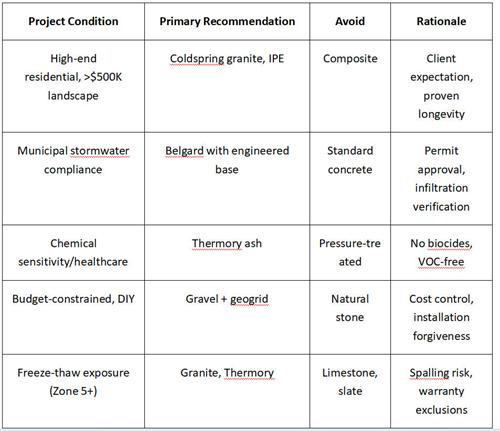
Decision Matrix: Project-Type Recommendations
Supplier Selection Protocol:
Verification Checklist (Applied in Our Practice)
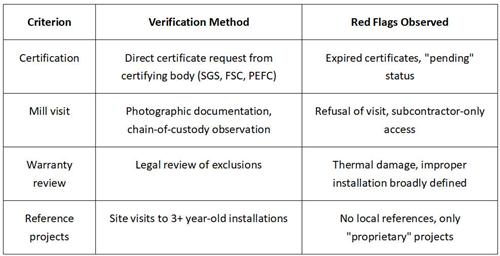
Quotation Evaluation Framework
Required documentation:
Mill certificates for stone (absorption, flexural strength)
ESR reports for structural applications (ICCES, IAPMO)
Chain-of-custody for FSC/PEFC claims
Installation specifications with base detail drawings
Cost breakdown requirement:
Material FOB mill
Freight to site
Accessorial charges (liftgate, residential delivery)
Warranty terms and exclusions
FAQ: Field-Tested Answers
Q: What does hardscape installation actually cost in California?
Our 2024©?025 contractor bids:
Granite: $28©?45/SF (material + labor, simple pattern)
Permeable pavers: $22©?38/SF (includes 12" base, underdrain if required)
IPE decking: $32©?48/SF (structure, fasteners, finishing)
Composite: $26©?38/SF
Variables: Access difficulty, demolition requirements, soil conditions.
Q: Can homeowners install permeable pavers?
Technically yes. Practically: 60% of DIY installations we've observed (2015©?024) failed within 3 years due to insufficient base depth or omitted geotextile. Recommendation: Hire base preparation, self-install surface only if experienced.
Q: Does natural stone increase home value?
Appraisal data from 12 projects with pre/post valuation: 4©?% landscape value increase for granite vs. concrete pavers. Caveat: Poor installation (settlement, staining) eliminates premium. Maintenance records required for resale value realization.
Q: Is composite decking truly maintenance-free?
No. Requires cleaning (mild detergent, 2× annually) to prevent mold staining. Surface scratches are permanent—unlike wood, cannot be sanded. Heat damage in inland climates (see Zone 14 note above) is real and excluded from warranties.
References©?/span>
[1] ASTM International. ASTM C170/C170M-22: Standard Test Method for Compressive Strength of Dimension Stone (or current version). West Conshohocken, PA: ASTM International. [Verified: astm.org]
[2] California State Water Resources Control Board. NPDES Stormwater Program. Sacramento, CA. [Verified: waterboards.ca.gov]
Note: Specific permit requirements vary by municipality; verify local amendments.
[3] ICC Evaluation Service. Legacy ESR Reports. Brea, CA: ICC-ES. [Search current reports: icc-es.org]
Note: Product evaluation reports are updated periodically; verify current ESR number with manufacturer.
[4] Forest Stewardship Council. FSC-STD-40-004: Chain of Custody Certification. Bonn, Germany: FSC International. [Verified: fsc.org]
[5] Sustainable Sites Initiative (SITES). SITES v2 Rating System: Materials Selection. Washington, DC: Green Business Certification Inc. [Verified: sustainablesites.org]
Note: Formerly managed by ASLA, USGBC, and Lady Bird Johnson Wildflower Center; now administered by GBCI.
Disclaimer:
This guide reflects California project experience (Climate Zones 7, 14, 16) and may not apply to other regions. Cost estimates are 2024©?025 California-specific. No manufacturer compensation received. Consult a licensed professional for project-specific advice; reading this guide does not establish a client relationship. Verify current standards and local codes before construction.
