



——A Supply Chain Consultant's Field Guide Based on 12 Years of Factory Audits
Emma Gray,a supply chain consultant specializing|Last updated date: March 2026|Next review date: January 2027
Choosing the right furniture manufacturing partner is one of the most consequential decisions for any furniture brand. Over my 12 years managing sourcing operations for brands ranging from Kickstarter-funded startups to established retailers doing $50M+ annual revenue, I've learned that success hinges on balancing three factors—quality, lead time, and price. Industry veterans call this the "impossible triangle," where optimizing one factor often strains the others. But I've found that with systematic evaluation and the right relationship framework, you can achieve a workable equilibrium that supports sustainable growth.
The Three Pillars: Understanding the Trade-Offs
Before evaluating specific partners, understand how these three factors interact in practice:
Quality encompasses craftsmanship consistency, material specifications, process controls, and quality assurance systems. In my audits, I've seen factories with identical equipment produce vastly different defect rates based solely on management discipline.
Lead Time includes sampling speed, production scheduling reliability, and logistics coordination. I once worked with a factory that quoted 45 days consistently but delivered in 60-75 days for 18 months straight—unacceptable for seasonal inventory.
Price involves not just unit costs, but MOQ flexibility, payment terms impact on cash flow, and hidden costs (tooling, packaging, compliance testing).
The Reality: You rarely maximize all three. My framework helps you intentionally prioritize based on your business model, then negotiate the other factors upward.
Step 1: Define Your Requirements Before Contacting Factories
Vague requirements lead to mismatched partnerships. I require clients to complete this specification before I initiate factory searches:
Product Category Specialization
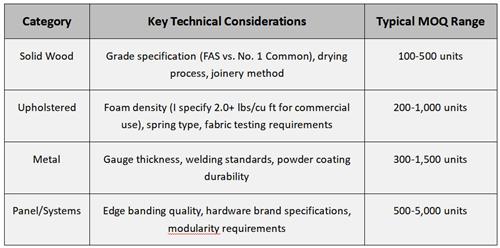
Volume Planning
Be honest about your trajectory. I advise startups to find factories that accept developmental partnerships—smaller initial orders with explicit understanding of scaling timelines. One factory I work with in Vietnam started with a 50-unit MOQ for a DTC brand now doing 15,000 units annually with them.
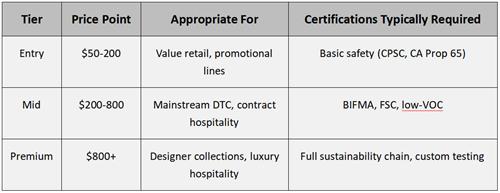
Quality Tier Targeting
Step 2: Sourcing Channels—Where I Actually Find Partners
After auditing 200+ factories across 8 countries, here's my assessment of sourcing channels:
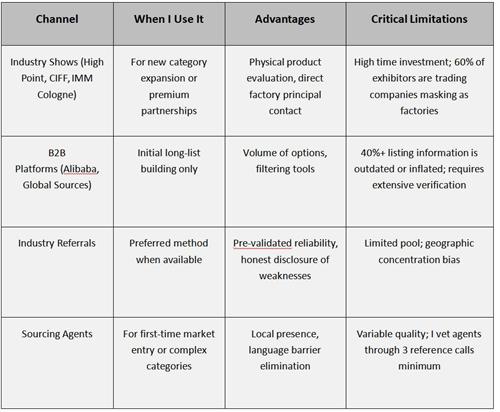
My Screening Protocol: Before visiting or deep engagement, I verify: business license (through local government databases where possible), export license validity, claimed certifications (direct inquiry to certifying bodies), and factory age (older isn't always better, but <3 years raises capital stability questions).
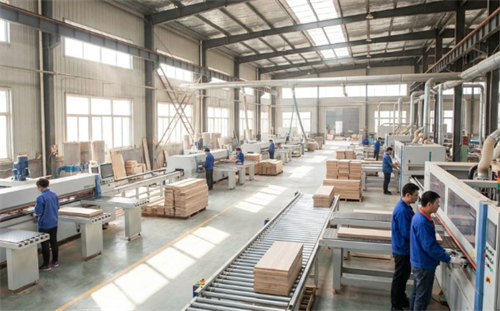
Step 3: Quality Evaluation—What I Check Beyond the Sample
Samples can be misleading. I've received perfect samples from factories that couldn't maintain that standard in production. My evaluation framework:
Material Verification
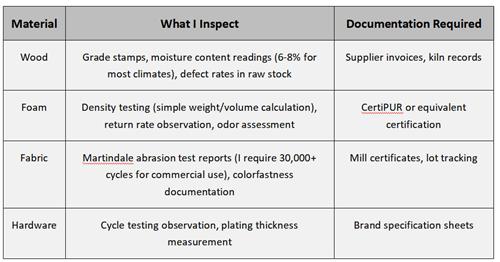
Construction Analysis
I photograph and document:
Joinery: Mortise-and-tenon vs. dowel vs. screw-and-plate—each has appropriate applications, but I reject disguised weak joints
Corner blocks: Presence and attachment method in upholstered frames
Finish work: Evenness, overspray control, sanding quality under magnification
Quality Control Systems
I ask direct questions and observe:
Is there a dedicated QC team, or do production workers self-check? (I prefer dedicated teams with reporting independence)
What is the AQL (Acceptable Quality Level) standard? (I specify 2.5 for critical defects, 4.0 for minor)
Are there in-process inspections, or only final audit? (Best practice: multiple checkpoints)
On-Site Factory Assessment Checklist
Based on my audit template developed over 12 years:
Environmental Indicators
Factory floor cleanliness (correlates strongly with quality discipline)
Material storage conditions (off ground, climate-controlled where needed)
WIP (work-in-process) organization and labeling
Capability Indicators
Equipment age and maintenance records (I look for PM logs)
Worker skill demonstration (I request to see complex operation samples)
Engineering staff presence and CAD capability
Management Indicators
Production planning board or system visibility
Documentation availability (work instructions, spec sheets posted)
Willingness to share past QC reports (redacted for client privacy)

Step 4: Lead Time Management—Setting Realistic Expectations
Time Component Breakdown (Based on 2023-2024 Project Averages)
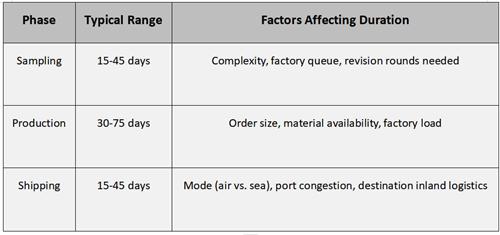
Critical Insight: I add 20% buffer to factory-quoted timelines for planning purposes. Factories consistently underestimate, and the cost of stockout usually exceeds holding cost.
Delay Prevention Strategies I've Implemented
Material Risk Mitigation:
For a mid-century modern chair line I managed, we pre-positioned walnut veneer in the factory's bonded warehouse, cutting 2 weeks from production starts and insulating against price spikes.
Communication Architecture:
I establish weekly video calls during production, not just email updates. The visual component catches issues 10-14 days earlier than text reports.
Shared project management boards (I use Trello or Monday.com with factory access) create transparency without constant prodding.
Calendar Awareness:
Chinese New Year: Factories typically close 2-4 weeks; I plan no deliveries February-March
Q4 capacity crunch: Many factories prioritize large, established clients; new relationships need orders placed by August for November delivery
Step 5: Price Negotiation—Protecting Value While Managing Cost
Cost Structure Transparency
I require factories to provide this breakdown:
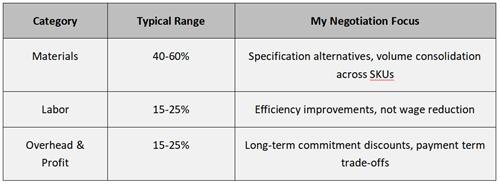
Negotiation Tactics That Preserve Relationships
MOQ Flexibility: Rather than demanding immediate large orders, I negotiate ramp schedules: "Start at 200 units, confirm 1,000-unit pricing if we reach that within 12 months." This aligns incentives.
Packaging Optimization: For a recent DTC furniture client, we redesigned packaging to achieve 15% more units per container—equivalent to 8% unit cost reduction without touching product quality.
Payment Structure: Standard 30/70 (deposit/balance) is typical, but I've negotiated 20/30/50 (deposit/shipment sample approval/final) for complex first orders, reducing risk without straining factory cash flow excessively.
Warning Signs of "Too Good to Be True" Pricing
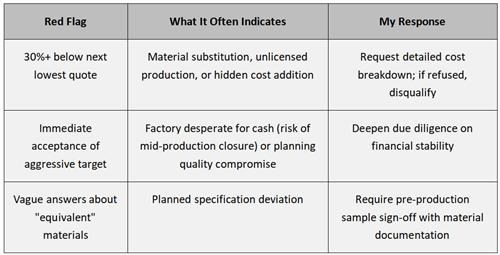
Step 6: Contractual Protection—Documenting the Relationship
I work with international trade attorneys to structure agreements covering:
Intellectual Property
Explicit design ownership transfer upon payment
Tooling ownership and return rights if relationship terminates
Non-compete provisions (geographic and temporal scope)
Quality Assurance
Detailed specification incorporation by reference
Inspection rights and third-party inspection authorization
Defect rate thresholds triggering rework, replacement, or refund rights
Operational Terms
Delivery windows with liquidated damages (I typically negotiate 1-2% per week late, capped at 10%)
Force majeure definition (I narrow this to prevent abuse)
Dispute resolution mechanism (I prefer Hong Kong or Singapore arbitration for China-based factories)
Post-Shipment Accountability
Warranty period and claim process
Spare parts availability commitment
Recall cooperation obligations
Critical Red Flags: When I Walk Away
Through painful experience, I've developed these automatic disqualifiers:
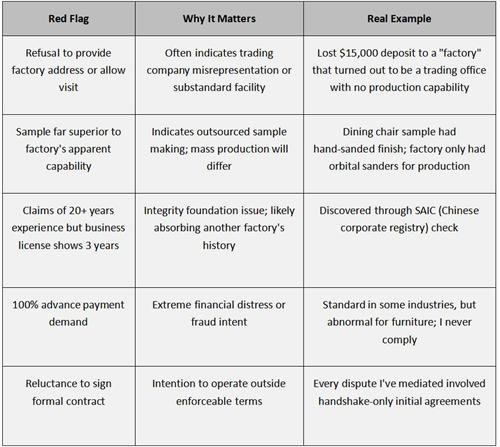
Case Study: From First Contact to Production Partnership
Client Context: A US-based DTC furniture brand, $2M annual revenue, launching upholstered dining chair line. I managed this sourcing process Q2-Q4 2023.
Timeline & Actions:
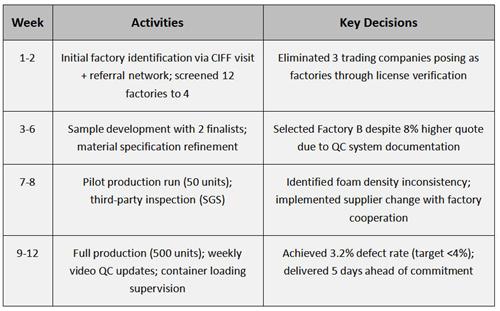
Problems Encountered & Solutions:
Foam density variance: Root cause was factory's foam supplier changing formulations without notice. Solution: Approved secondary foam supplier, implemented incoming material testing protocol.
Communication delays: Initial contact person left factory; 10-day information gap. Solution: Established backup communication protocol with factory owner directly.
Outcome: Client reordered within 30 days of receipt; 18-month relationship now producing 3,000+ units monthly.
FAQ
Q: What's a realistic MOQ for a furniture startup?
For development partnerships, I've negotiated 50-200 units for initial orders. Expect to pay 15-25% premium over quoted 500+ unit pricing. The investment is worthwhile for relationship testing.
Q: How long should sampling actually take?
15-45 days is typical, but complexity matters. A simple wood chair might be 2 weeks; a multi-material sofa with custom mechanisms could be 8 weeks. I always confirm material lead times separately—upholstery fabrics often drive the timeline.
Q: Sourcing agent or direct factory relationship?
For first-time entrants to Asian manufacturing, I recommend agents for the first 12-18 months. The fee (typically 5-10%) buys mistake prevention worth multiples of that cost. Transition to direct once you've developed internal capability.
Q: How do I protect designs?
Contracts are necessary but insufficient. I also: (1) work with factories that don't serve my direct competitors, (2) release designs in phases when possible, (3) maintain some proprietary processes or materials in-house, and (4) build relationships where long-term mutual benefit exceeds copying incentive.
Q: Which certifications actually matter?
BIFMA for commercial/office (indicates durability testing), FSC for wood sustainability claims (required by many corporate clients), GREENGUARD for indoor air quality (healthcare and education markets). I verify all certificates directly with issuing bodies—counterfeits are common.
Summary
Selecting a manufacturing partner is not transactional procurement—it's strategic relationship building. The factories I've maintained 5+ year partnerships with share common traits: transparent communication when problems arise, investment in improvement when we request it, and alignment between their growth trajectory and ours.
Immediate Action Framework:
This Week: Complete the requirement specification in Step 1
Month 1: Identify and screen 5-8 factories using Step 2-3 protocols
Month 2: Develop samples with 2 finalists; conduct on-site audits
Month 3: Pilot production with comprehensive inspection
Month 4-6: Evaluate and scale or pivot based on performance
Start with small test orders, document everything, and build systematically. The right partner is worth the patient search.
About the Author
Emma Gray is a supply chain consultant specializing in furniture and home goods manufacturing. Over 12 years, she has managed sourcing operations for brands from pre-launch startups to $100M+ retailers, conducted 200+ factory audits across China, Vietnam, Mexico, and Eastern Europe, and helped clients navigate 15+ product recalls without business interruption. She is a contributing member of the American Home Furnishings Alliance (AHFA) Supply Chain Committee and speaks regularly at High Point Market and Las Vegas Market on manufacturing ethics and risk management.
Disclaimer
This article reflects general industry practices and the author's professional experience. Specific pricing, timelines, and regulatory requirements vary by product category, jurisdiction, and market conditions. Readers should conduct independent due diligence and engage qualified legal and trade professionals for contract matters. No client relationship is created by reading this material.
