



A Tile Contractor's 15-Year Perspective on Making the Right Choice
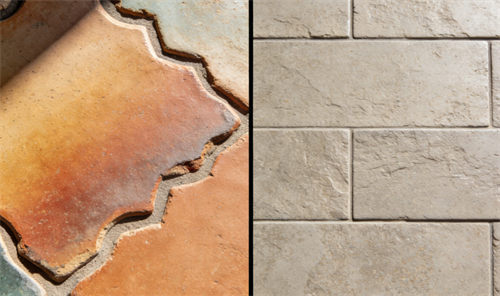
John Smith,tile contractor|Last updated date: March, 2026|Next review date: January 2027
I've installed over 500,000 square feet of tile in the past 15 years—from historic Brooklyn brownstone renovations to Miami high-rise new builds. The artisan versus industrial debate isn't abstract theory for me; it's a decision I guide clients through weekly, often standing in their unfinished kitchens with sample boards in hand.
Both tile types have legitimate roles. The wrong choice isn't about aesthetics—it's about mismatching material capabilities to real-world demands. I've replaced too many failed installations where homeowners prioritized looks over performance, or conversely, missed design opportunities by defaulting to "safe" industrial options.
This article shares my field-tested framework for making this decision correctly the first time.
Defining the Categories: What I Actually Install
Artisan Tiles: Beyond the Marketing Romance
"Artisan" gets overused. In my work, this category includes:
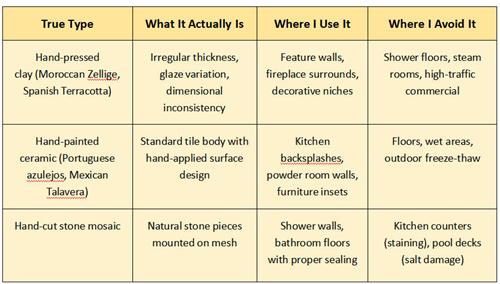
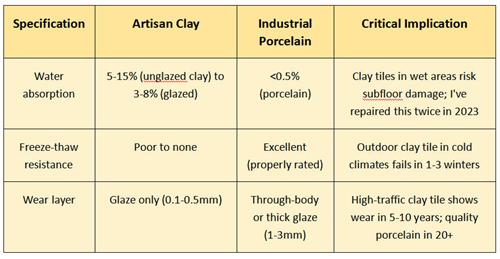
Critical Reality: The "defect beauty" marketing obscures functional limitations. I've removed 3-year-old Zellige installations from shower floors where the high absorption rate caused substructure damage. The charm isn't worth the repair cost.
Industrial Tiles: Precision with Purpose
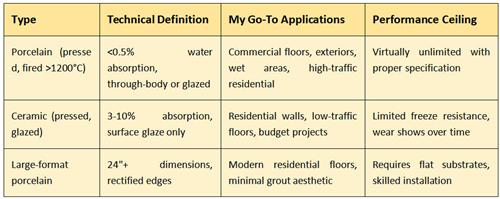
"Industrial" suggests compromise; in my experience, it means engineered performance:
Price Comparison: My Project Budgets (2023-2024)
Material Costs (Installed Northeast US Market)
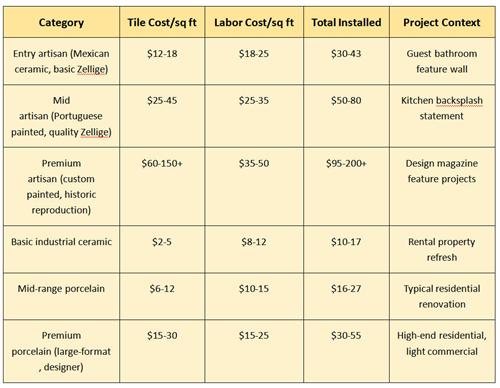
Labor Multiplier Effect: Artisan tile installation takes 2-3x longer. I charge $25/sq ft for complex Zellige layouts versus $12/sq ft for standard porcelain. This isn't markup—it's the reality of lippage control, custom cuts, and pattern management.
Hidden Cost Alert: Artisan tiles often require 15-20% overage for selection and breakage versus 10% for industrial. On a 100 sq ft kitchen backsplash, that's $300-800 in additional material cost.
Quality and Durability: Technical Performance vs. Aesthetic Preference
Absorption and Structural Integrity
My Performance-Based Recommendations
Shower Floors: I specify only porcelain or natural stone with proper sealing. The 2023 International Residential Code (IRC) doesn't prohibit clay tiles in showers, but my insurance carrier does—I've seen the water damage claims.
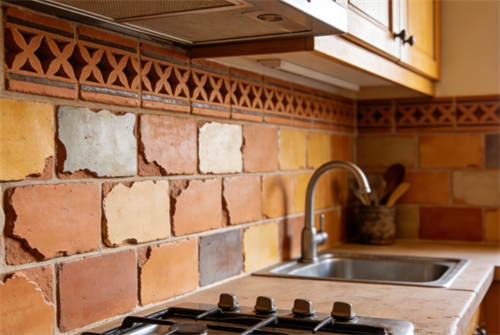
Kitchen Backsplashes: Either category works. I recently completed a Park Slope kitchen with Zellige backsplash and marble-look porcelain floor—hybrid approach at $45/sq ft total material cost versus $65/sq ft for all-artisan.
Exterior Applications: Only freeze-rated porcelain or specific exterior-grade ceramic. I won't warranty artisan tile outdoors in zones with hard freezes—learned this on a 2019 Hamptons project requiring full replacement.
Style and Aesthetics: Design Integrity vs. Trend Cycles
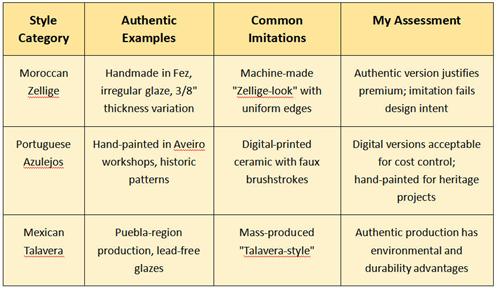
Artisan Tile Authenticity Spectrum
Industrial Tile Evolution
The "cold perfection" criticism of industrial tile is outdated. Current technologies I specify regularly:
Digital glaze printing: Porcelain indistinguishable from Calacatta marble at 1/3 the maintenance
Textured finishes: Anti-slip coefficients (DCOF >0.42) exceeding safety requirements without aesthetic compromise
Large-format minimalism: 48"x48" panels with 1/16" grout lines achieving seamless appearance
Trend Observation: I'm specifying more "warm industrial"—porcelain with intentional tonal variation that references artisan character while maintaining performance specs. This hybrid approach grew from 10% to 35% of my residential projects 2020-2024.
Installation Reality: What Actually Happens on Site
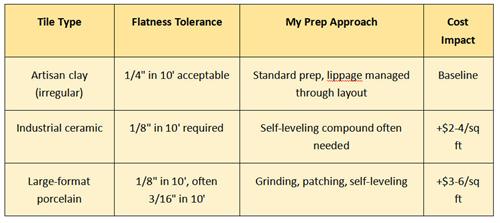
Substrate Requirements
Installation Complexity Factors
Artisan Tile Challenges I Manage:
Thickness variation: I cull tiles on site, sorting by thickness for consistent courses
Irregular sizing: Custom spacers, frequent dry-layouts, 30% slower production rate
Glaze sensitivity: Wax coatings require specific cleaning pre-grout; I've seen permanent hazing from improper removal
Industrial Tile Challenges:
Large-format handling: 48"x48" panels require two-person sets, specialized suction equipment
Lippage sensitivity: Rectified edges show any substrate imperfection; I use leveling clips on tiles >24"
Pattern alignment: Book-matched marble-look porcelain requires meticulous layout planning
Grout and Sealant Specifications
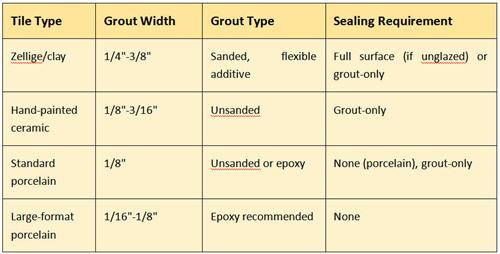
Decision Framework: My Client Consultation Process
Step 1: Functional Requirements Audit
I ask clients to rank these priorities:
Maintenance tolerance (willingness to seal, special cleaning)
Budget ceiling (including realistic labor costs)
Performance demands (kids, pets, rental property, resale timeline)
Aesthetic non-negotiables (specific design vision)
Step 2: Location-Specific Recommendations
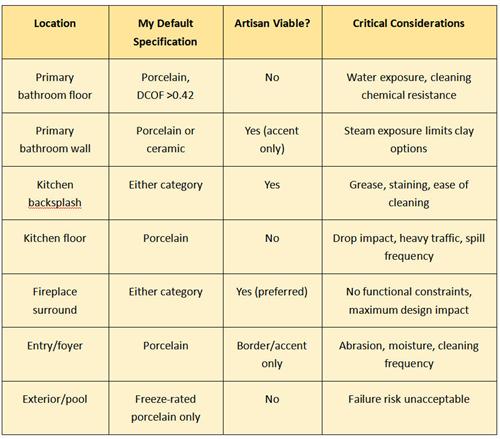
Step 3: Hybrid Solutions (My Most Common Recommendation)
Rather than binary choice, I often specify:
Artisan feature wall + Industrial floor (bathrooms)
Artisan backsplash focal point + Industrial field tile (kitchens)
Artisan fireplace + Industrial surrounding surfaces (living spaces)
This approach typically achieves 70% of the design impact at 50% of the all-artisan cost.
Brand Assessment: What I Actually Specify
Artisan Tile Sources
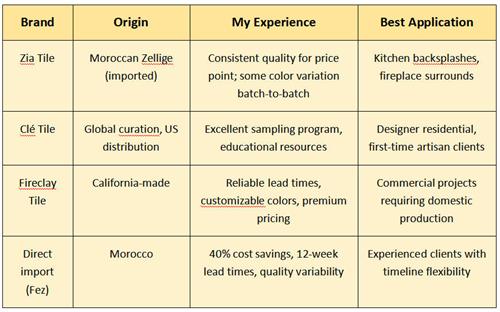
Industrial Tile Sources
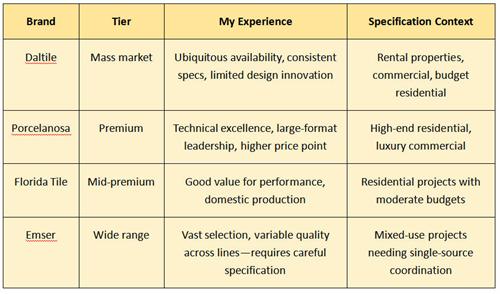
Procurement Note: I maintain active trade accounts with all listed brands. I receive no promotional consideration; specifications reflect actual installation experience and warranty performance.
Case Study: Recent Project Comparison
Project A: All-Artisan Brooklyn Townhouse
Scope: Three-story renovation, 2,400 sq ft Client Priority: Design magazine feature, no budget constraint My Specification: Zellige kitchen backsplash, hand-painted powder room walls, terracotta mudroom floor Total Tile Investment: $78,000 (material + labor) Timeline: 14 weeks (artisan sourcing and installation extended schedule) Outcome: Published in Architectural Digest; client reports ongoing maintenance (annual sealing) acceptable
Project B: Performance-First Family Home
Scope: New build, 3,800 sq ft, three children under 10 Client Priority: Durability, low maintenance, resale value My Specification: Large-format porcelain throughout living areas, ceramic subway tile bathrooms, no artisan materials Total Tile Investment: $34,000 Timeline: 6 weeks Outcome: Client reports zero maintenance issues 18 months post-installation; appraiser noted "premium finishes" contributing to value
Project C: Hybrid Approach (My Typical Recommendation)
Scope: Renovation, 1,900 sq ft pre-war apartment Client Priority: Design character with practical constraints My Specification: Artisan Zellige kitchen backsplash focal point; porcelain "marble" field tile; porcelain bathroom floors with artisan accent niche Total Tile Investment: $28,000 Timeline: 9 weeks Outcome: 90% of design impact of all-artisan at 60% of cost; maintenance limited to annual backsplash sealing
Frequently Asked Questions (From Actual Client Conversations)
Q: Will artisan tile hurt my resale value?
Not inherently, but poor installation will. I've seen Zellige backsplashes add $15,000+ to perceived kitchen value in Brooklyn; I've also seen DIY artisan installations require $8,000+ remediation before sale. The differentiator is professional installation with documented waterproofing.
Q: Can I install artisan tile myself?
Technically possible; I don't recommend it. The lippage control, pattern management, and sealing requirements demand experience. Of 12 DIY artisan installations I've been called to repair, 9 required complete removal.
Q: Do industrial tiles really look like real stone now?
From 6 feet, quality porcelain is visually indistinguishable. The difference is thermal (stone feels cooler) and edge detail (stone has slight irregularity). For my clients, the maintenance advantage of porcelain usually outweighs these distinctions.
Q: How often do I need to seal artisan tiles?
Unglazed clay: Annually in wet areas, every 2-3 years in dry areas. Glazed artisan: Grout-only sealing annually. I provide clients written maintenance schedules; adherence predicts long-term satisfaction.
Q: What's your personal preference?
I have porcelain in my own kitchen floor (kids, dog, reality) and Zellige in my powder room (design joy, low functional demand). The right material for the right application—my professional philosophy matches my personal practice.
Summary and Action Steps
The artisan versus industrial choice isn't about good versus bad—it's about appropriate application. My 15-year installation record shows three consistent success patterns:
Match material capabilities to functional demands (absorption, wear, freeze resistance)
Budget realistically for total installed cost, not just material price
Invest in professional installation—the labor cost difference between categories is substantial, but cutting corners fails both types
Immediate Next Steps:
Collect physical samples of 3-5 options in your consideration set
Test in your actual space—lighting conditions transform tile appearance
Consult a qualified installer before final purchase; I provide 30-minute preliminary consultations to assess substrate conditions and realistic costs
Request warranty documentation in writing; reputable suppliers provide this without hesitation
About the Author
John Smith is a licensed tile contractor with 15 years of field installation experience across residential and commercial projects. He has installed over 500,000 square feet of tile, ranging from historic reproductions to large-format porcelain systems. He holds certifications from the National Tile Contractors Association (NTCA) and Tile Council of North America (TCNA), and serves as an expert witness in tile failure litigation.
Disclaimer
This article reflects the author's professional experience and industry standards as of 2024. Tile performance characteristics, pricing, and availability vary by region and supplier. Always verify product specifications with manufacturers and consult qualified professionals for project-specific advice. The author maintains trade accounts with brands mentioned but receives no promotional compensation; brand references reflect actual installation experience only.
